
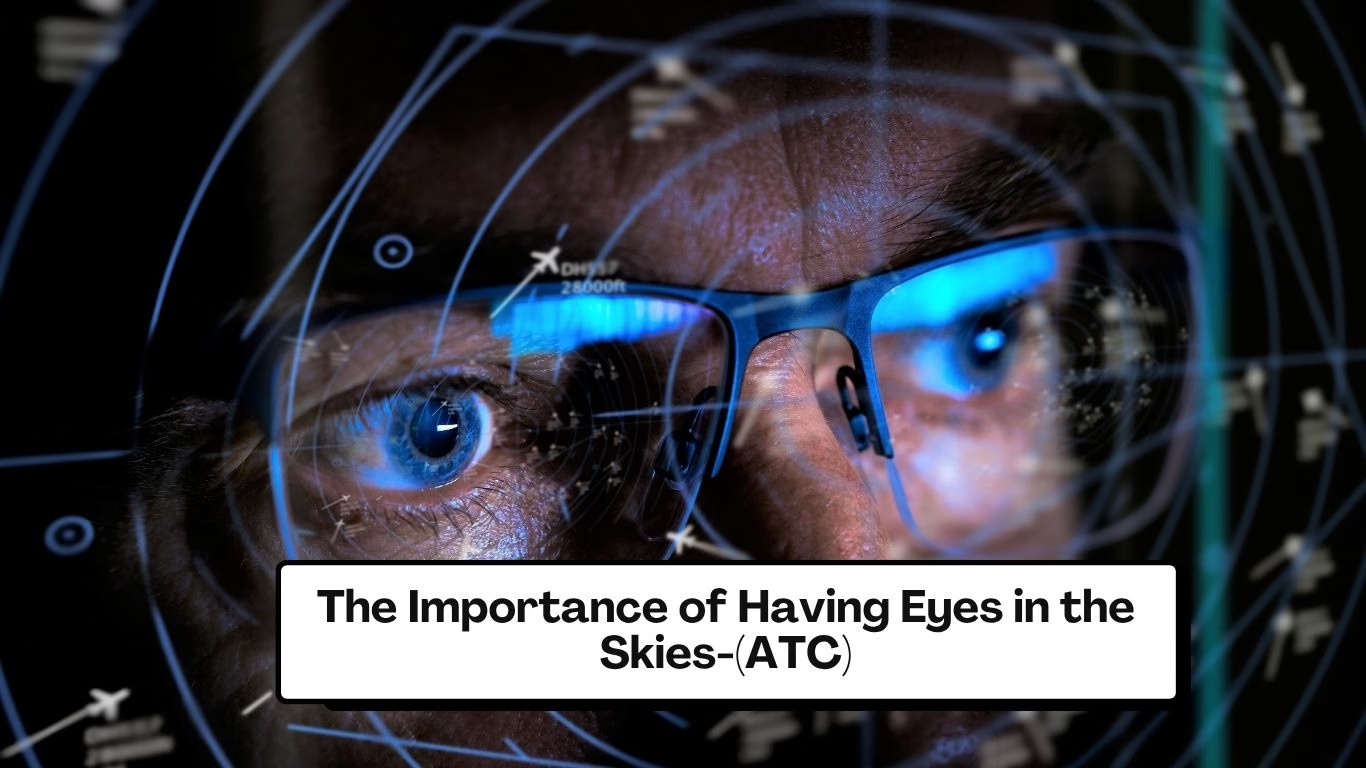
Significance of Air Traffic Control
The need for air traffic control arose when, on April 7, 1922, a mid-air collision of two passenger-carrying biplanes took place. It was observed after this crash that the aviation industry is getting larger day by day. More aircraft are being flown in the air, so there is a necessity to keep them well separated to avoid collisions, which is becoming difficult for pilots as air traffic increases and airways become congested. At this point, the role of ATCO became clear and important.
In 1946, in the United States, an inspection of the Air traffic control practices, the predecessor to ICAO, adjusted worldwide guidelines to the American standards. This led to the formation of a globally unified Air Navigation System (Kearns, 2018).
Air Traffic Control is a service provided for:
Doc-4444, 2007
a) preventing collisions:
1) between aircraft, and
2) on the maneuvering area between aircraft and obstructions; and
b) expediting and maintaining an orderly flow of air traffic.
A licensed person, responsible for providing Air Traffic Control Services, is known as an Air Traffic Control Officer. An ATCO’s job is to make aircraft move safely and efficiently in the air and on the ground. They are responsible for maintaining safe separation of the aircraft. Their job is to interact with a complex system that requires them to have situational awareness, decision-making skills, and technological knowledge.
As explained by Kearns in his book Fundamentals of International Aviation 2018, they are responsible for maintaining safe separation between aircraft:
- And other aircraft.
- And ground-based obstructions that could be buildings, towers, hills, and mountains, etc.
- And airspace boundaries.
Methods Used by Air Traffic Controllers for Aircraft Separation
The aircraft is separated by the air traffic controllers in three ways, as explained below:
1. Visual Reference
In visual referencing, the Controller guides the pilot by looking out from the window of the control tower of an airport. And ensures that the aircraft is moving safely in the maneuvering area. The pilots are instructed by the air traffic controller to maintain visual separation from other aircraft during the landing and approach phase and to use visual references to stay on course and to use the proper glide path to the runway. ATC officers are trained to provide clear and concise instructions to pilots regarding visual references.
2.Surveillance Radar
This technique uses a radar facility or other technology to ensure safe separation between the aircraft by using precise information regarding their positions. The ATCO determines the ways to coordinate, prioritize, and separate the traffic by considering the heading, speed, and altitude.
3. Procedural Separation
Procedural separation is used in areas where the radar service is not available, as it covers only 10% of the World’s surface, so the aircraft are separated by the controllers using the rules and pilot position reports (Kearns, 2018).
Read More About: Salary of Air Traffic Controller
Aviation-Looks
Roles of an Air Traffic Controller
The ATCOs perform four different roles according to the phase of flight and the category of airspace (A, B, C, D, E, F, G):
1. Aerodrome Control
They are located in the control tower at an airport and are responsible for the safe and efficient movement of aircraft in the maneuvering areas of the airport, which include the taxiways and apron. This role is generally played by the ATCO at the ground position, whereas the one at the tower position is responsible for the safe landing and takeoff of the aircraft.
2. Approach Control
The ATCOs at the approach control tower located near the airport are responsible for the orderly flow and sequencing of the aircraft that are arriving or departing from the airport’s terminal area.
3. Area Control
The Area control tower is located at the central position of the airspace, and the controller is responsible for the separation of aircraft, keeping in mind the safety and efficiency, while they are in cruise phase.
4. Oceanic Control
The oceanic control tower is generally located near the coastline, and the controller is responsible for the safe separation and navigation of the aircraft flying over the oceans.
Air Traffic Flow Management (ATFM)
Air Traffic Flow Management acts as a major support service for Air Traffic Control, as it helps in the maximum utilization of available airspace (ICAO, 2008), and it can be explained as a service established that contribute to a safe, orderly, and expeditious flow of air traffic. ATFM is defined as per ICAO:
A service established to contribute to a safe, orderly, and expeditious flow of air traffic by ensuring that ATC capacity is utilized to the maximum extent possible, and that the traffic volume is compatible with the capacities declared by the appropriate ATS authority
(Doc-4444, 2007)
The process of ensuring the efficient use of the airspace and balancing its demand and capacity is known as Air Traffic Flow Management, whose objective is to enhance the safety, efficiency, and predictability of the air traffic, as well as provide a safe, orderly, and expeditious flow of air traffic.
Read More About: History of Air Traffic Control
Aviation-Looks
Traditionally, the ATFM was done based on “first come, first serve” and: equitable access to airspace” (ICAO, 2014). Flight plans are the premise of ATFM. A Strategic ATFM plan is intended to determine expected congestion in problematic regions to work with traffic streams, by and large a while to 1 week before the flight activity dates. Day-to-day traffic plans are developed, generally 1day before the arranged flight operations, including transformations and changes in accordance with the brilliant flight plans that have been proactively created. ATFM includes various strategies and incorporates frameworks that can be basic or on the other hand complex. One instrument usually used to oversee air traffic stream is the utilization of ground delay programs where airplane takeoffs are deferred (Arblaster, 2018).
References
- Arblaster, M., 2018. Air Traffic Management economics, regulation, and governance. s.l.:Elsevier.
- Doc-4444, 2007. doc-4444 PANS/ATM. fifteenth ed. s.l.:International Civil Aviation Organization.
- ICAO, 2008. SAM ROADMAP FOR AIR TRAFFIC FLOW MANAGEMENT, s.l.: s.n.
- ICAO, 2014. Manual on Collaborative Air Flow Management, second ed. Doc 9971, AN/485, s.l.: s.n.
- Kearns, S. K., 2018. Fundamentals of International Aviation. London and New York: Routledge.
Leave a Reply