

In the aviation industry, pilots are the ones who get the highest salaries. Over their 30-year careers, they can earn approximately $4- $6 million, with additional benefits such as bonuses, retirement plans, and travel allowances.
The pilot’s responsibility is not only simply flying the aircraft, but they also have more responsibilities like monitoring weather conditions, communicating with the air traffic controllers and other ground crew, tackling emergencies, and making quick decisions in favor of the smooth aircraft operation in the air to ensure the safety of the aircraft, its crew, and the passengers.
The whole aviation industry globally relies on pilots in order to ensure and maintain efficient global air transportation. As their job nature is very demanding, their salary expectation are also high.
| Airline Type | Salary Range Yearly |
|---|---|
| Major Airlines | First Officers: $80K – $150K, Captains: $250K – over $400K |
| Regional Airlines | First Officers: $50K – $90K, Captains: $80K – over $150K |
Factors that Affect Pilot Salary
Starting a pilot journey isn’t easy; it requires rigorous training (including ground school, flight training, and flight hours), and flight hours will cost a lot of money. Not every pilot gets the same salary; their salary is affected by various factors:
- Geographical location.
- The type of aircraft they are flying.
- Experience level of the pilot.
- The airlines for which they are flying.
Types of pilots
There are different types of pilots in the aviation industry based on training, licensing, type of aircraft flying, etc. The primary types of pilots in the aviation industry are given as follows.
Student pilot
The pilots flying under the supervision of a certified flight instructor are known as student pilots. It is also the first step of every pilot in their career. The student pilot holds the student pilot license. Most student pilots fly under the supervision of the instructor, but they are also permitted to fly solo under some specific conditions but they are not permitted to carry passengers during flight.
Sports Pilots
The sports pilots operate only light sports aircraft. For the sport pilot, a sport pilot license is mandatory. They face fewer requirements than private pilots in terms of medical and training requirements. But they have flying restrictions; they can only fly during the day. like in the United States airspace. For getting a sports pilot license, a minimum of 20 flight hours is mandatory, with other requirements.
Private Pilot
Private pilots can fly a variety of aircraft. They are also allowed to carry passengers. They hold a private pilot’s license. Usually, a, a noncommercial pilot holds a private pilot license. To get a private pilot license, a minimum of 40 flight hours is mandatory, along with a medical certificate and also passing a written and flight test is mandatory for a private pilot license.
Commercial Pilots
A commercial pilot can work in charter operations, corporate aviation, aerial photography, and corporate aviation. But still, they can’t fly as airline pilots. To become an airline pilot, a commercial pilot license is mandatory. For this reason, a minimum of 250 flying hours is mandatory, including night flying, advanced maneuvers, and cross-country flights. To get a commercial license, candidates have to pass written and flight tests alongside medical examinations.
Airline Transport Pilot
These pilots are permitted to operate an airline flight. In airlines, mostly, they act as a pilot in command of a flight. They operate scheduled airline flights. To become an airline pilot, the candidate must have an airline pilot license (ATPL). For ATPL, a minimum of 1,500 flight hours is required, and passing a written and practical exam is mandatory for the license.
Certified Flight Instructor
Flight instructors are those pilots who train new student pilots. They play a vital role in the aviation industry as they train the next generation of pilots. Mostly, they work in aviation academies. Flight instructors hold certified flight instructor licenses. To become a flight instructor, a commercial pilot license or an airline pilot license is required, after which the candidate has to do an instructor course. The candidate also has to pass the written and practical tests.
Helicopter Pilots
Helicopter pilots fly rotary-wing aircraft. Most helicopter pilots operate for tourism, medical evacuation, law enforcement, and military operations. To become a helicopter pilot, a candidate has to acquire a private helicopter pilot license (PHPL) or a commercial helicopter pilot license (CHPL). To get a helicopter pilot license, they require 40 to 150 flight hours, depending on the type of license, whether it is private or commercial.
Cargo or Freight Pilot
The cargo pilots work for the transportation of the cargo instead of passengers. They work in companies like UPS, FedEx, etc. These pilots mostly hold a commercial pilot license or an airline pilot license, depending on the size of the aircraft they are operating and airline regulations.
Military Pilots
As the name shows, military pilots work for the military. Mostly they fly fighter aircraft, reconnaissance planes, transport aircraft, and helicopters. Their training is more intense than that of commercial pilots, as their task is different from that of commercial pilots. Their licensing requirements and certification are different on the commercial side and vary country by country.
Agriculture Pilots
They are also known as crop duster pilots. Their main task is to fly low and spray pesticides, seeds, and fertilizers over farmlands. Mostly, agriculture holds a commercial pilot license (CPL) with an agricultural flying endorsement. For agriculture pilots, 200-plus flight hours are required with specialized training in low-altitude training as they have to fly low for agricultural purposes.
Functions of the Pilot
The main function of the pilot is the safe and efficient operation of the aircraft in the aviation industry. The other functions include checking and ensuring the proper weight and balance of the aircraft. A preflight inspection ensures adequate fuel supply to the aircraft before the flight. Reviewing flight plans before the flight, monitoring and calibrating aircraft systems, and navigating the aircraft up to the final destination.
One of the vital functions of the pilot is to respond effectively to any uncertain event during flight for the safety of the aircraft, its crew, and the passengers on board. Those uncertain events can consist of any kind of emergency, like bad weather conditions, engine failure, bird strikes, high turbulence conditions, etc.
Requirements to Become a Pilot Globally
ICAO Annex 1- Personnel Licensing defines all the requirements for becoming a pilot. The major ones are:
- The minimum age requirement to get different pilot licenses is a little bit different. A student Pilot License (SPL) has a Minimum age of 16 years, and a Private Pilot License (PPL) has a Minimum age of 17 years. Commercial Pilot License (CPL) has a Minimum age of 18 years, and Airline Transport Pilot License (ATPL) has a Minimum age of 21 years.
- In terms of education, a minimum high school diploma or equivalent is mostly required. However, some airlines require or prefer a bachelor’s degree in aviation or any relevant field.
- In terms of medical, according to ICAO, candidates have to pass a class 1 medical for a commercial and airline pilot license, and a class 2 medical is required for a private pilot license. For the student pilot candidate’s Class 3 medical certificate.
- For flight training and licensing, candidates have to enroll in certified flight schools or an aviation academy. For (PPL),40 flying hours are required. For (CPL), 200-250 flying hours are required. And for (ATPL), a minimum of 1500 flying hours is required. Also, candidates have to pass written, en oral, and practical flight tests.
- In terms of language requirements, candidates have to meet ICAO level 4 proficiency to operate internationally.
- To fly large commercial aircraft, a specific type rating is required.
- To become an airline or commercial pilot, a clean criminal record is required. Also, the pilot has to demonstrate situational awareness, teamwork skills, and strong decision-making ability
Pilots’ Salaries in the United States
The latest salaries of pilots in 2025 are given as follows.
| Airlines | Captain Salary (Yearly) | First Officer Salary (Yearly) |
|---|---|---|
| American Airlines | $350,000+ | From $150,000 to over $200,000 |
| United Airlines | $350,000+ | $150,000 |
| Delta Airlines | $365,000, with seniors up to $472,000+ | From $115,000 to $310,000 |
| Southwest Airlines | $364,000+ | From $100,000 to $270,000 |
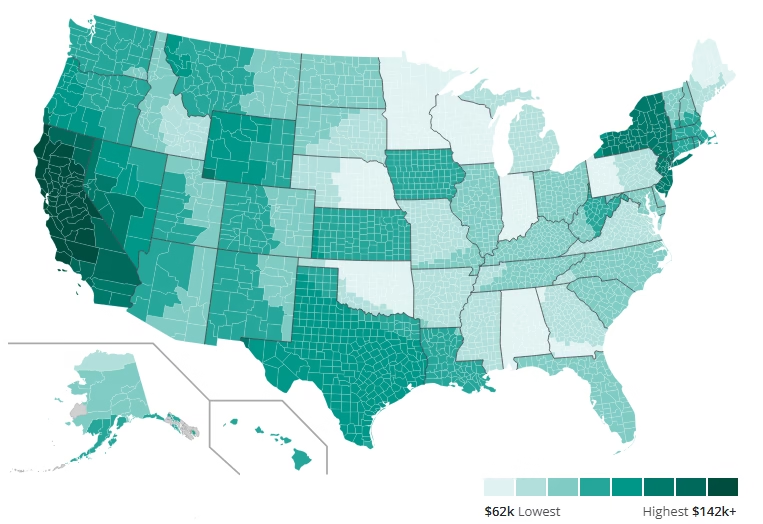
Highest Salary Paying States in the US
| Rank | States | Avg. Salary (year) | Hourly Rate $ |
|---|---|---|---|
| 1 | California | 128,074 | 61.57 |
| 2 | Nevada | 111,774 | 53.74 |
| 3 | Texas | 103,628 | 49.82 |
| 4 | Louisiana | 94,975 | 45.66 |
| 5 | Iowa | 95,515 | 45.92 |
| 6 | New Jersey | 117,895 | 56.68 |
| 7 | New York | 117,977 | 56.72 |
| 8 | Oregon | 102,347 | 49.21 |
| 9 | Kansas | 95,935 | 46.12 |
| 10 | Wyoming | 102,069 | 49.07 |
| 11 | Connecticut | 93,220 | 44.82 |
| 12 | West Virginia | 91,756 | 44.11 |
| 13 | Utah | 89,841 | 43.19 |
| 14 | Delaware | 90,706 | 43.61 |
| 15 | Arizona | 90,971 | 43.74 |
| 16 | Massachusetts | 93,638 | 45.02 |
| 17 | Illinois | 89,529 | 43.04 |
| 18 | Montana | 96,274 | 46.29 |
| 19 | New Mexico | 93,283 | 44.85 |
| 20 | Washington | 95,918 | 46.11 |
| 21 | Rhode Island | 94,168 | 45.27 |
| 22 | Ohio | 85,541 | 41.13 |
Pilots’ Salaries in Europe.
In Europe, the salary of first officers is between 30,000 and 50,000 euros per year, and captains in major European airlines earn between 150,000 and 250,000 plus. Overall salaries of pilots in different European countries in 2025 are given as follows.
| Country | Lowest Salary (Yearly) | Highest Salary (Yealy) |
|---|---|---|
| Switzerland | 105,950 CHF | 160,000 CHF |
| Luxembourg | €95,500 | €96,000 |
| United Kingdom | £30,000 | £37,556 |
| Germany | €60,000 | €120,000 |
| France | €28,000 | €47,000 |
| Netherlands | €60,000 | €155,000 |
| Ireland | €65,162 | €200,000 |
| Denmark | 836,500 DKK | 425,100 DKK |
| Belgium | €66,140 | €195,200 |
| Norway | 469,800 NOK | 1,628,100 NOK |
| Austria | €42,320 | €129,000 |
| Sweden | 502,200 SEK | 1,440,700 SEK |
| Finland | €53,380 | €158,700 |
| Italy | €37,800 | €123,400 |
| Spain | €27,480 | €87,520 |
| Portugal | €29,320 | €85,700 |
| Greece | €22,420 | €71,280 |
| Poland | 76,280 PLN | 222,300 PLN |
| Czech Republic | 597,800 CZK | 1,908,800 CZK |
| Hungary | 4,585,100 HUF | 15,360,400 HUF |
Pilots’ Salaries in Gulf Countries
The salaries of pilots in Gulf countries in 2025 are between $84,000 – $150,000.
| Country | Lowest Salary (Yearly) | Highest Salary (Yearly) |
|---|---|---|
| United Arab Emirates | 231,000 AED | 660,500 AED |
| Saudi Arabia | 161,600 SAR | 531,700 SAR |
| Qatar | 152,000 QAR | 472,100 QAR |
| Kuwait | 13,900 KWD | 42,320 KWD |
| Bahrain | 17,260 BHD | 51,400 BHD |
| Oman | 21,540 OMR | 57,800 OMR |
Read More About: Emirates Airlines Pilot Salary Breakdown 2025
Aviation Looks



Leave a Reply