
Fastest Passenger Plane on Earth
When people think about speed in aviation, one question often comes to mind: What is the fastest passenger plane on Earth?
For decades, commercial aviation has focused on fuel efficiency, safety, and passenger comfort rather than outright speed. However, there was a time when passengers could fly faster than twice the speed of sound, crossing the Atlantic Ocean in just a few hours.
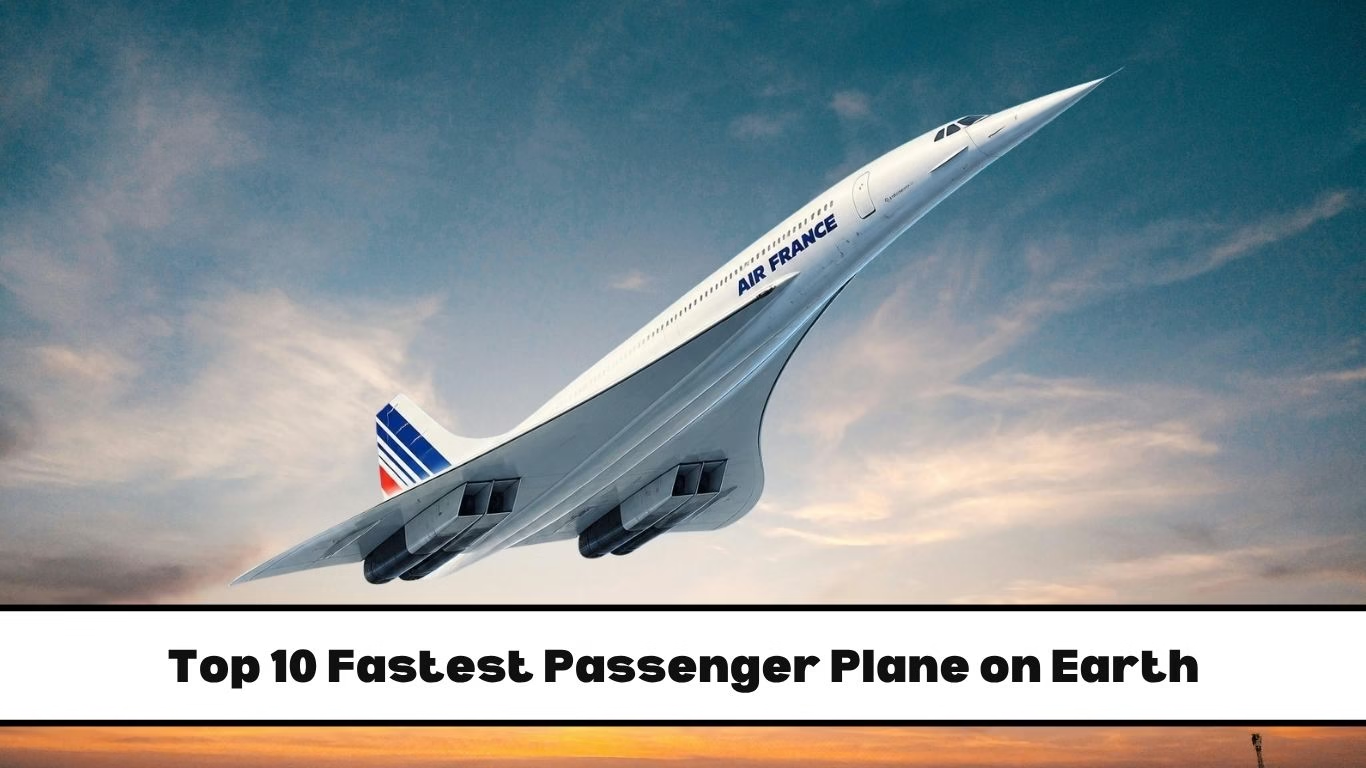
The Concorde remains the fastest passenger plane on Earth to operate successfully in regular commercial service.
Concorde at a Glance
| Specification | Details |
|---|---|
| Top Speed | Mach 2.04 |
| Speed in km/h | 2,180 km/h |
| Speed in mph | 1,354 mph |
| Cruise Speed | Mach 2.02 |
| Passenger Capacity | 92–128 |
| Service Years | 1976–2003 |
| Operators | British Airways & Air France |
Flying at over twice the speed of sound, Concorde could complete the London–New York journey in approximately 3.5 hours, compared with today’s average of 7–8 hours.
Even after retiring in 2003, no commercial passenger aircraft has surpassed Concorde’s operational success.
Why Was Concorde So Fast?
Concorde was engineered specifically for supersonic travel.
Its incredible performance came from several innovations:
- Delta wing design
- Four Rolls-Royce/Snecma Olympus engines
- Advanced heat-resistant materials
- Aerodynamic nose that could lower during takeoff and landing
- Cruise altitude of around 60,000 feet
At this altitude, air resistance was significantly lower, allowing Concorde to maintain exceptional speeds efficiently.
Top 10 Fastest Passenger Planes on Earth
1. Concorde
Maximum Speed: Mach 2.04 (2,180 km/h)
Concorde remains the undisputed king of commercial speed.
- Crossed the Atlantic in half the normal time
- Luxury travel experience
- Served VIPs, celebrities, and business travelers
- More than 50,000 flights completed
2. Tupolev Tu-144
Maximum Speed: Mach 2.15 (2,300 km/h)
Although technically faster than Concorde, the Soviet Tu-144 experienced numerous technical issues.
Why it wasn’t as successful:
- Limited passenger operations
- High maintenance costs
- Safety concerns
- Short commercial lifespan
3. Boeing 747-8
Maximum Speed: 988 km/h
Nicknamed the Queen of the Skies, the Boeing 747-8 remains among the fastest modern passenger aircraft.
4. Boeing 787 Dreamliner
Maximum Speed: 913 km/h
Known more for fuel efficiency than speed, the Dreamliner combines modern technology with excellent long-haul performance.
5. Airbus A350
Maximum Speed: 945 km/h
The Airbus A350 offers:
- Quiet cabins
- Lower fuel consumption
- Long-range capability
- Advanced composite construction
6. Boeing 777
Maximum Speed: 950 km/h
One of the world’s most popular long-haul aircraft.
7. Airbus A380
Maximum Speed: 1,020 km/h
Despite being the world’s largest passenger aircraft, the A380 is surprisingly fast for its size.
8. McDonnell Douglas MD-11
Maximum Speed: 945 km/h
The MD-11 served numerous airlines before gradually being replaced by newer aircraft.
9. Airbus A330
Maximum Speed: 913 km/h
Reliable, efficient, and widely used across international airlines.
10. Boeing 767
Maximum Speed: 913 km/h
Still operating worldwide for both passenger and cargo services.
Speed Comparison Table
| Aircraft | Top Speed | Mach |
|---|---|---|
| Concorde | 2,180 km/h | 2.04 |
| Tu-144 | 2,300 km/h | 2.15 |
| Airbus A380 | 1,020 km/h | 0.89 |
| Boeing 747-8 | 988 km/h | 0.86 |
| Boeing 777 | 950 km/h | 0.84 |
| Airbus A350 | 945 km/h | 0.89 |
| MD-11 | 945 km/h | 0.88 |
| Boeing 787 | 913 km/h | 0.85 |
| Airbus A330 | 913 km/h | 0.82 |
| Boeing 767 | 913 km/h | 0.80 |
Read More About: 10 Fastest Single-Engine Planes in the World
Why Don’t Passenger Planes Fly Faster Today?
Many people wonder why airlines no longer fly at Mach 2.
- Fuel Costs: Supersonic aircraft consume significantly more fuel than subsonic jets.
- Noise Restrictions: Flying faster than sound creates a sonic boom, which is prohibited over land in many countries.
- High Maintenance: Supersonic aircraft require specialized materials and maintenance, increasing operating costs.
- Limited Passenger Capacity: Concorde carried fewer than 130 passengers, making each seat considerably more expensive.
Will Supersonic Passenger Travel Return?
The future looks promising.
Several aerospace companies are developing the next generation of supersonic passenger aircraft.
Expected improvements include:
- Lower emissions
- Quieter engines
- Reduced operating costs
- Sustainable aviation fuel compatibility
- Improved passenger comfort
These aircraft aim to make ultra-fast travel practical again.
Interesting Facts About the Fastest Passenger Plane on Earth
- Concorde crossed the Atlantic in around 3 hours and 30 minutes.
- It cruised at 60,000 feet, nearly twice the altitude of many commercial jets.
- The aircraft became approximately 13 cm (5 inches) longer during flight because of heat generated at supersonic speeds.
- Passengers could sometimes see the curvature of the Earth from its cruising altitude.
- Concorde’s nose could tilt downward to improve pilots’ visibility during takeoff and landing.
Advantages of High-Speed Passenger Aircraft
- Shorter travel times
- Increased productivity for business travelers
- Faster international connections
- Premium travel experience
- Technological innovation
Disadvantages
- High ticket prices
- Increased fuel consumption
- Environmental concerns
- Sonic boom restrictions
- Higher maintenance expenses
Final Thoughts
The fastest passenger plane on Earth remains the legendary Concorde, an engineering achievement that transformed commercial aviation by making routine supersonic travel a reality. Although today’s airlines prioritize efficiency, comfort, and sustainability over outright speed, the dream of faster travel is far from over.
With new generations of supersonic aircraft under development, travelers may once again experience journeys that take hours instead of an entire day. Until then, Concorde continues to symbolize the pinnacle of speed in commercial aviation and remains one of the most iconic aircraft ever built.




Leave a Reply